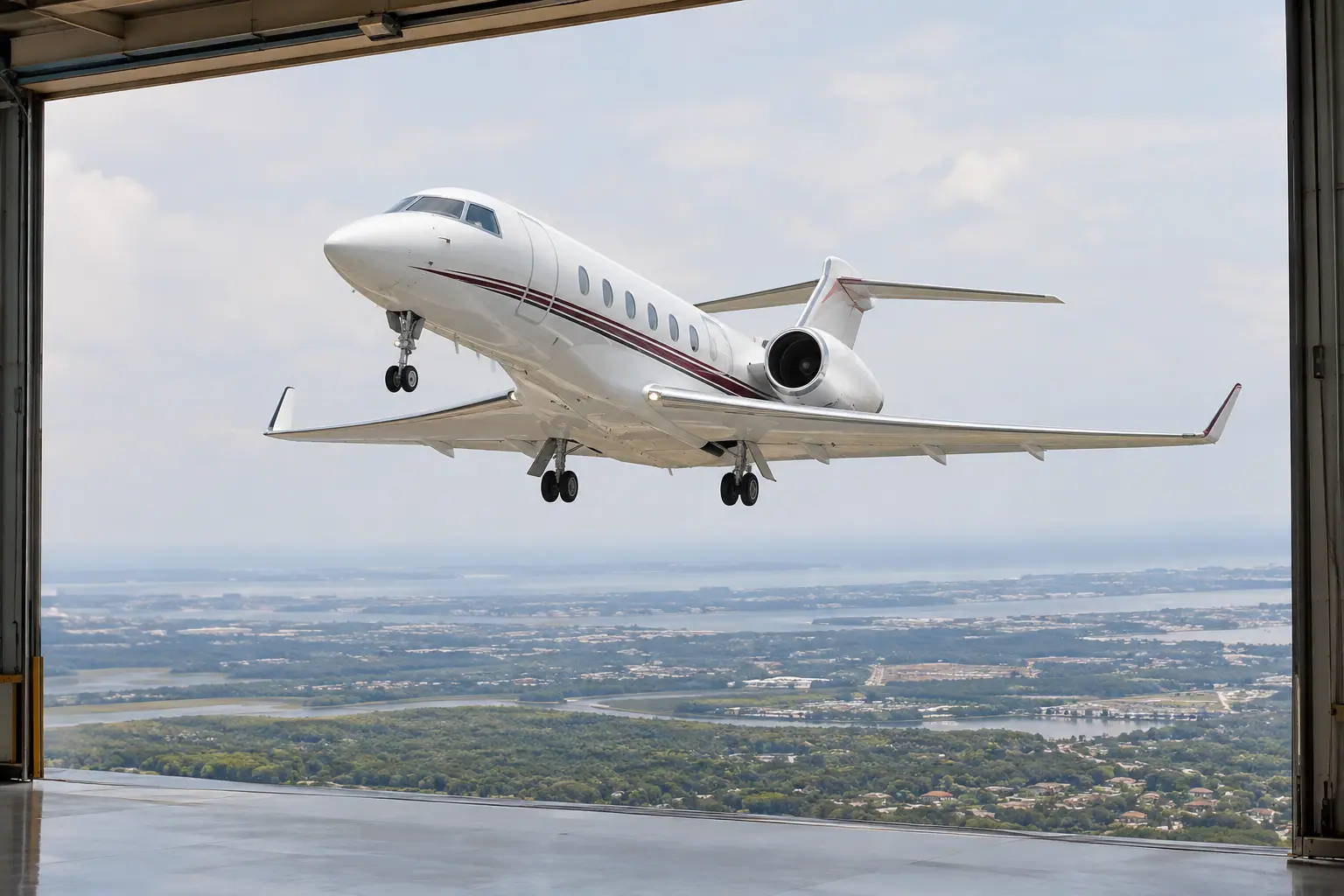
Private jet price per hour by route
Private jet price per hour by route starts with the aircraft class rate. A light jet runs $3,800 to $5,800 per hour in 2026 estimates. The New York to Miami run prices at $10,000 to $15,000.
- Home
- Routes
Hourly rates are the building block, but nobody bills you for a round number of hours. A quote for a specific trip is distance divided by cruise speed, plus taxi, climb and descent, plus a routing allowance, multiplied by the operator's hourly rate for that aircraft. Change the city pair and the total moves even when the rate holds steady. Understanding the hourly figure first makes every route comparison easier to follow.
The tables on each route page carry light jet times and estimated prices, and the same math applies up the fleet. A midsize jet bills $5,200 to $7,800 an hour, a super-midsize $7,200 to $10,000, and a heavy $9,500 to $14,500. A turboprop sits lower at $2,200 to $3,500. These are ranges because two operators flying the same aircraft type rarely quote the same number, and you will usually see the range narrowed once a specific tail is assigned.
What an inbound flight costs
An inbound flight to a high-traffic airport carries the same hourly math, but ground handling and FBO fees at the destination can add to the estimate. Sample route pricing, like $10,000 to $15,000 for New York to Miami, assumes standard handling. A short hop such as Los Angeles to Las Vegas, 199 nautical miles, estimates $4,000 to $6,000 in a light jet even though the airborne time is under an hour. If the operator has to reposition an empty aircraft to your departure airport, then that ferry time may appear in the quote. Ask for it in writing.

New York → Miami
- 2h 37m
- $10,000–$15,000
- 949 nm
Los Angeles → Las Vegas
- 0h 47m
- $4,000–$6,000
- 199 nm

Los Angeles → San Francisco
- 0h 59m
- $4,000–$6,000
- 279 nm

Los Angeles → Aspen
- 1h 51m
- $7,000–$10,500
- 634 nm

Chicago → New York
- 1h 49m
- $7,000–$10,500
- 619 nm
Miami → Nassau
- 0h 42m
- $4,000–$6,000
- 161 nm
Washington, DC → New York
- 0h 46m
- $4,000–$6,000
- 194 nm
Dallas → Las Vegas
- 2h 34m
- $9,500–$15,000
- 925 nm
What an outbound flight costs
An outbound flight prices the same way, and the return leg is often quoted with it. Round trips and one-ways can price differently on the same city pair. A one-way from Chicago to New York, 619 nautical miles, estimates $7,000 to $10,500 in a light jet. If you book a one-way and no nearby aircraft is available, then an empty leg back may be priced into your total. Charter brokers act as your agent under DOT Part 295 rules, and the flight itself is flown by an operator holding a Part 135 certificate with operational control.

New York → Los Angeles
- 6h 15m
- $23,500–$36,000
- 2,129 nm

New York → Palm Beach
- 2h 30m
- $9,500–$14,500
- 902 nm

New York → Aspen
- 4h 43m
- $18,000–$27,500
- 1,503 nm
New York → The Hamptons
- 0h 30m
- $4,000–$6,000
- 82 nm
Dallas → Houston
- 0h 48m
- $4,000–$6,000
- 208 nm
New York → Boston
- 0h 41m
- $4,000–$6,000
- 158 nm
Los Angeles → Cabo San Lucas
- 2h 16m
- $8,500–$13,000
- 808 nm
Chicago → Miami
- 2h 48m
- $10,500–$16,000
- 1,023 nm
How route times and prices are
Each route page starts with the great-circle distance between airports, adds a 5% routing allowance for airways and weather deviations, then divides by the class cruise speed. On a 2,129 nautical mile route like New York to Los Angeles, that allowance matters. The result gets 0.3 hours added for taxi, climb and descent, and a one-hour minimum applies so short hops do not price below the floor. Multiply the final hours by the aircraft class hourly rate range.
Times shown are for a light jet at 430 knots cruise unless otherwise labeled. The same distance flown in a heavy jet at 470 knots runs slightly faster but costs more per hour. Prices are estimates in current market ranges, not firm quotes. Density altitude and runway length at fields like Centennial, elevation 5,885 feet, can affect which aircraft types are practical on a given day. When a runway is short or hot, then payload and fuel stops change the plan, and that changes the price.
Questions
What is the private jet price per hour by route for a light jet?
Light jets bill $3,800 to $5,800 per hour in 2026 estimates. A 949-nautical-mile route such as New York to Miami comes out at about 2 hours 37 minutes of billable time and $10,000 to $15,000. Shorter pairs like Washington, DC to New York, 194 nautical miles, land at $4,000 to $6,000 because the one-hour minimum applies.
Why does the same hourly rate produce different totals on different routes?
Because billable hours are distance over cruise speed plus 0.3 hours for taxi, climb and descent. A 199-nautical-mile hop from Los Angeles to Las Vegas prices at $4,000 to $6,000, while New York to Aspen at 1,503 nautical miles runs 4 hours 43 minutes and $18,000 to $27,500 in the same class. Same rate, very different total.
How much does a midsize jet cost on a typical route?
Midsize jets bill $5,200 to $7,800 per hour. On a 1,023-nautical-mile run like Chicago to Miami, that comes to roughly 2 hours 48 minutes of billable time. The estimate scales from the light jet figures shown on the route page, so expect a midrange total between the light and super-midsize numbers.
Do turboprops change the hourly math?
Yes, and usefully on short legs. Turboprops bill $2,200 to $3,500 per hour at about 300 knots cruise. On a route under 200 nautical miles, the lower hourly rate can offset the slower speed. On longer pairs the speed penalty grows, and a light jet at 430 knots usually makes more sense.
Are the route prices firm quotes?
No. They are estimates built from distance, routine routing allowances and current class hourly rate ranges. Operators price each trip on aircraft availability, crew duty limits and airport fees. A broker working under DOT Part 295 as your agent will return an actual quote, and that number is the one worth comparing.
What about international legs like Miami to Nassau?
Miami to Nassau is 161 nautical miles, about 42 minutes of billable time, and estimates $4,000 to $6,000 in a light jet. Because it crosses a border, you clear US Customs and Border Protection on the return. The operator handles the paperwork, but build time into your schedule and expect handling fees.