Private jet price per hour Miami Opa Locka Executive
Charter pricing starts with the hourly rate, then adds fees and taxes. A light jet runs $2,800 to $4,500 per hour on Part 135 flights. Four FBOs serve the field, and runway 9L/27R measures 8,002 feet.
- airport codes
- KOPF · OPF
- airport alt.
- 8 ft
- longest runway
- 8,002 ft
- to New York
- 0 mi
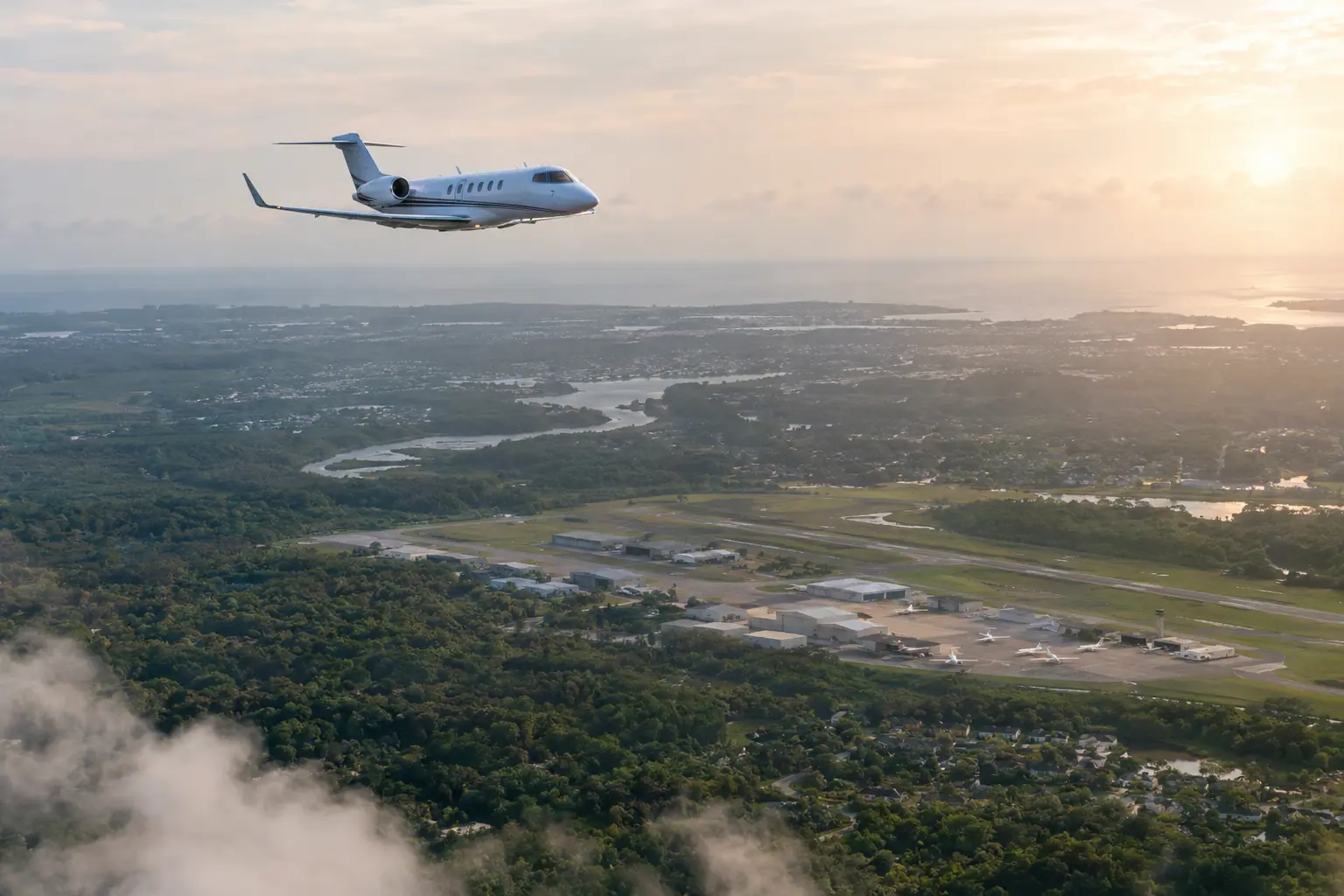
The private jet price per hour Miami Opa Locka Executive quote you see is rarely the final bill. It covers the aircraft, crew, fuel, and standard operating costs for the flight hour. On top of that you pay landing and handling fees, which vary by FBO: Atlantic Aviation, Signature Aviation, Jet Aviation, and Fontainebleau Aviation all operate here, and each sets its own fees. Your broker discloses these before you book, acting as your agent under DOT Part 295 rules. Light jets at Opa Locka typically quote $2,800 to $4,500 per flight hour for short trips.
Aircraft size drives the rate more than distance. Turboprops and light jets fit short hops and small runways, while midsize and super-midsize jets cost more per hour but fly farther and faster. For a run from Opa Locka to Teterboro, 2,227 miles, you need at least a super-midsize or large cabin jet. That trip prices differently than a 45-minute hop to Palm Beach. The hourly rate for a midsize jet often falls between $4,500 and $7,000 per hour depending on the operator and date.
Operators hold FAA Part 135 certification and exercise operational control of every flight. Your broker arranges the trip but does not operate the aircraft. When you request quotes, ask for the operator's certificate number and the tail number proposed for your flight. If the trip crosses into international airspace, customs coordination through CBP is part of the plan. Charter brokers act as agents under DOT Part 295, not as carriers, so the quote you sign should name the operator clearly.
Pricing also shifts with demand. Peak season in South Florida runs roughly November through April, when snowbirds and event traffic push hourly rates higher. Summer afternoons bring thunderstorms and high density altitude, which can limit payload or require a fuel stop. Empty leg flights, when an aircraft repositions without passengers, sometimes list at a fraction of the normal rate, though availability is unpredictable. A jet chartered at Opa Locka on short notice may price higher than a flight booked a week out.
Runways and field conditions at Opa
Opa Locka has a longest runway of 8,002 feet, with the field sitting just 8 feet above sea level. That runway length and low elevation support everything from light jets to large cabin aircraft on most days. The field has multiple runways, so traffic can be sequenced without the delays you see at Miami International. Runway 9L/27R at 8,002 feet handles large cabin jets at Opa Locka year-round. If you are flying a heavy jet on a hot afternoon, then the operator will calculate performance using the day's density altitude, which can reach about 2,500 feet at 115°F.
| Runway | Length | Width | Surface |
|---|---|---|---|
| 09L/27R | 8,002 ft | 150 ft | Asphalt |
| 12/30 | 6,800 ft | 150 ft | Asphalt |
| 09R/27L | 4,309 ft | 100 ft | Asphalt |
FBOs and ground handling at Opa Locka
Four FBOs operate at Opa Locka: Atlantic Aviation, Signature Aviation, Jet Aviation, and Fontainebleau Aviation. Each offers fueling, hangar space, and passenger lounges, and each sets its own handling fees. Your broker should confirm which FBO the operator uses so you know the fee before you arrive. The FBO you use at Opa Locka affects the total cost as much as the hourly rate does, because handling fees for a midsize jet can run several hundred dollars per leg. Ask for an itemized quote that separates the hourly rate from FBO charges.
Best for
- Travelers comparing private jet price per hour Miami Opa Locka Executive quotes across multiple operators and aircraft categories.
- South Florida trips where Miami International crowds and long taxi times are worth avoiding.
- East Coast and Midwest routes, including Opa Locka to Teterboro at 2,227 miles and Opa Locka to Chicago Midway at 1,517 miles.
- International legs that need CBP coordination, since Opa Locka is a port of entry with customs available.
| Class | Typical runway need | Here |
|---|---|---|
| Turboprop | 3,300 ft+ | Fits |
| Light jet | 4,000 ft+ | Fits |
| Midsize jet | 5,000 ft+ | Fits |
| Super-midsize jet | 5,200 ft+ | Fits |
| Heavy jet | 5,600 ft+ | Fits |
Weather and density altitude by season
Density altitude at Opa Locka is highest in summer, when afternoon highs reach 88°F and the density altitude climbs to about 1,900 feet in July. That is mild compared with mountain airports, but it still affects takeoff distance and climb performance for heavily loaded jets. Spring and fall bring highs in the low to mid 80s and density altitude around 1,500 to 1,700 feet. Winter is the easiest season for performance, with January highs near 75°F and density altitude around 1,100 feet. If you fly a full load out of Opa Locka on a July afternoon, then expect the operator to calculate a longer takeoff roll. Wet days peak in August, with 26 wet days on average, so build some slack into summer schedules.
| Month | Avg high | Wet days | Density altitude |
|---|---|---|---|
| Jan | 75°F | 9 | 1,100 ft |
| Feb | 78°F | 11 | 1,300 ft |
| Mar | 81°F | 9 | 1,500 ft |
| Apr | 84°F | 11 | 1,700 ft |
| May | 86°F | 17 | 1,800 ft |
| Jun | 87°F | 25 | 1,900 ft |
| Jul | 88°F | 24 | 1,900 ft |
| Aug | 88°F | 26 | 1,900 ft |
| Sep | 87°F | 24 | 1,900 ft |
| Oct | 84°F | 18 | 1,700 ft |
| Nov | 80°F | 12 | 1,400 ft |
| Dec | 77°F | 11 | 1,200 ft |
Access and ground logistics
Opa Locka sits about 12 miles north of downtown Miami, closer to the city than Miami International for many addresses. The airport's local code is OPF, and it is a designated port of entry, so international arrivals clear customs on site. Passengers typically arrive through the FBO, park, and walk to the aircraft without a terminal. If your itinerary involves a customs stop, then confirm with your broker that the FBO can handle CBP processing for your arrival time. Ground transport to Miami Beach or Brickell takes roughly 25 to 40 minutes depending on traffic, so plan accordingly for early departures.
Private jet routes via Miami-Opa Locka
The 6 city pairs below span 199 to 2,129 nautical miles, with one-way light jet estimates running $4,000 to $36,000.



Inquiries for this field
What is the private jet price per hour Miami Opa Locka Executive for a light jet?
Light jets at Opa Locka typically quote between $2,800 and $4,500 per flight hour, depending on the operator, date, and trip length. That rate covers aircraft, crew, and fuel but not FBO handling or landing fees. For a short hop to Palm Beach, the hourly rate is only part of the total; ask for an itemized quote that includes all fees and taxes.
How much does a midsize jet cost per hour at Opa Locka?
Midsize jets often price between $4,500 and $7,000 per hour at Opa Locka, again depending on operator and demand. These aircraft carry more passengers and baggage and fly farther than light jets. For a route like Opa Locka to Chicago Midway, 1,517 miles, a midsize jet may be the most efficient choice. Request quotes from several operators to compare.
What is the longest runway at Opa Locka Executive?
The longest runway at Opa Locka is 8,002 feet, with the field elevation at 8 feet above sea level. That length supports large cabin jets on most days. On hot afternoons, density altitude can reach about 2,500 feet at 115°F, which reduces performance. The operator will calculate takeoff distance for your specific aircraft and load.
Which FBOs operate at Opa Locka and do they charge handling fees?
Four FBOs operate at Opa Locka: Atlantic Aviation, Signature Aviation, Jet Aviation, and Fontainebleau Aviation. Each charges its own handling and facility fees, which are separate from the hourly rate. Fees vary by aircraft size and services used. Your broker should disclose the FBO fee before you book so the total cost is clear.
Can I fly internationally from Opa Locka and clear customs?
Yes, Opa Locka is a port of entry, so international arrivals can clear customs on site. The operator and FBO coordinate with CBP for your arrival. If you are flying to the Caribbean or elsewhere, then allow extra time for customs processing. Confirm with your broker that the FBO can handle CBP for your scheduled arrival.
How does density altitude affect flights from Opa Locka in summer?
In summer, afternoon highs reach 88°F and density altitude climbs to about 1,900 feet in July, peaking near 2,500 feet at 115°F. Higher density altitude reduces engine performance and increases takeoff distance. For a fully loaded jet, the operator may reduce payload or adjust the flight plan. If you are flying on a hot afternoon, then expect the performance calculation to reflect those conditions.
Are empty leg flights available at Opa Locka?
Empty leg flights sometimes appear when an aircraft repositions without passengers, and they can price well below a standard charter. Availability is unpredictable and often short notice. If your schedule is flexible, then ask your broker to watch for empty legs matching your route. Treat the listed price as an estimate until the operator confirms.