Private jet price per hour Orlando Executive
A private jet price per hour Orlando Executive quote reflects the airframe class, not the field. Orlando Executive sits at 113 feet with a 6,004-foot runway and peak density altitude near 2,700 feet. We quote operator figures, not brochure rates.
- airport codes
- KORL · ORL
- airport alt.
- 113 ft
- longest runway
- 6,004 ft
- to New York
- 0 mi
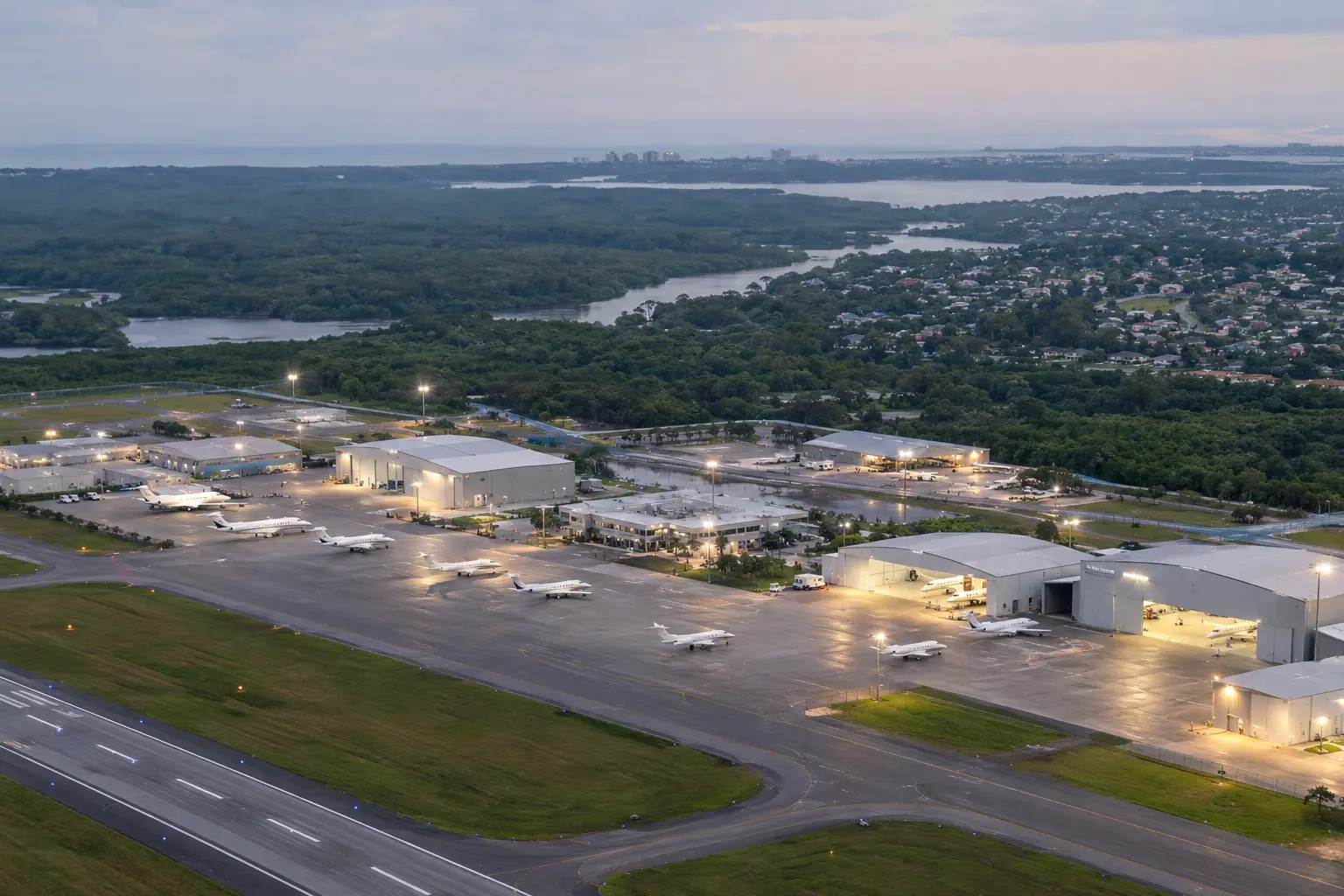
A private jet price per hour Orlando Executive quote starts with the airframe class, because the hourly rate follows the airplane more than the airport. Light jets tend to land in the lower band of the market, midsize jets sit above them, and turboprops come in under both on shorter legs. The executive airport itself is not the expensive part; it is a reliever field close to downtown Orlando with straightforward handling. Light jet pricing at Orlando Executive runs lower than midsize on comparable routes and hours.
For 2026, planning bands help but should not be mistaken for a contract. A light jet hourly figure typically falls in a range that suits short Florida hops and regional trips, midsize costs more per hour and carries farther, and turboprops hold the bottom of the range on routes under a few hundred miles. Turboprop and light jet bands at Orlando Executive cover most Florida routes under two hours. Remember that hourly rates usually assume a minimum daily billing, and that the flight time you pay includes positioning aircraft to Orlando and back out.
Distance tells you which class to ask about. Orlando Executive is roughly 2,033 miles from the Los Angeles basin and 2,227 miles from Teterboro, so transcontinental legs favor super-midsize and heavy jets, while Atlanta, Nashville and South Florida are light jet territory. Nonstop legs from Orlando Executive to the West Coast require midsize or heavy cabin classes. Ask your broker to show the empty leg board as well, since repositioning flights out of ORL can beat the standard hourly band when your dates are flexible. Charters are arranged through operators holding FAA Part 135 authority, and this site acts as the broker under DOT Part 295 rules.
Runway length and field notes at ORL
Orlando Executive has a 6,004-foot longest runway at 113 feet elevation, which handles light through heavy business jets without the runway constraints of smaller fields. The 6,004-foot runway at Orlando Executive accepts light, midsize and heavy business jets. That length matters on hot afternoons when performance margins shrink, and it is why crews run takeoff and landing distance numbers rather than assuming a number works because it is published. Single-runway operations mean sequencing with tower traffic, so slot times can be tighter during winter events than the field's size suggests.
| Runway | Length | Width | Surface |
|---|---|---|---|
| 07/25 | 6,004 ft | 150 ft | Asphalt |
| 13/31 | 4,625 ft | 100 ft | Asphalt |
FBO and ground handling
Sheltair is the FBO serving Orlando Executive, and your operator's handling request goes through that provider. Ground handling at Orlando Executive is coordinated through Sheltair for arriving charter traffic. Ask whether de-icing, catering and rental cars are arranged at booking so the arrival sequence is clear before departure day. Custody of the flight rests with the Part 135 operator, while we handle the comparison and the paperwork on your side of the transaction.
What Orlando Executive is best for
- Business trips to downtown Orlando and the I-4 corridor, since ORL keeps you on the east side of town
- Travelers flying to the parks, conventions at the Orange County Convention Center and area resorts without the MCO terminal
- Florida hops to Tampa, Miami and the coast, where light jets and turboprops keep hourly costs down
- Winter and spring event traffic, including the Arnold Palmer Invitational and the Citrus Bowl, when the field gets busy
| Class | Typical runway need | Here |
|---|---|---|
| Turboprop | 3,300 ft+ | Fits |
| Light jet | 4,000 ft+ | Fits |
| Midsize jet | 5,000 ft+ | Fits |
| Super-midsize jet | 5,200 ft+ | Fits |
| Heavy jet | 5,600 ft+ | Fits |
Heat, density altitude and timing
July density altitude at Orlando Executive reaches about 2,100 feet, and the peak at 115F climbs to roughly 2,700 feet, which is why crews compute performance before departure. Summer density altitude near 2,700 feet at Orlando Executive affects climb and runway margins on hot afternoons. June through September carries 22 to 26 wet days per month, and afternoon storms build quickly across central Florida, so morning departures are often smoother. If your schedule is fixed to late afternoon in July, then expect added taxi time and a performance-limited climb, especially in a light jet at gross weight. January brings highs near 70F with 900 feet density altitude, giving the best margins of the year.
| Month | Avg high | Wet days | Density altitude |
|---|---|---|---|
| Jan | 70°F | 7 | 900 ft |
| Feb | 75°F | 9 | 1,200 ft |
| Mar | 80°F | 7 | 1,500 ft |
| Apr | 83°F | 11 | 1,700 ft |
| May | 87°F | 12 | 2,000 ft |
| Jun | 88°F | 22 | 2,100 ft |
| Jul | 89°F | 26 | 2,100 ft |
| Aug | 88°F | 25 | 2,100 ft |
| Sep | 86°F | 22 | 1,900 ft |
| Oct | 82°F | 13 | 1,700 ft |
| Nov | 77°F | 9 | 1,300 ft |
| Dec | 73°F | 7 | 1,100 ft |
Getting to and away from the airport
Orlando Executive sits a few miles east of downtown Orlando, with quick connections to State Road 408 and the East-West Expressway, so ground transfers arrive fast compared with the international airport. Passenger access at Orlando Executive links to downtown via SR 408 and the East-West Expressway. If you are heading to the attractions or the convention center, then allow for afternoon traffic on I-4 regardless of how easy the airport side is.
Private jet routes via Orlando
The 6 city pairs below span 199 to 2,129 nautical miles, with one-way light jet estimates running $4,000 to $36,000.





Inquiries for this field
What does a private jet price per hour Orlando Executive charter cover?
The hourly figure for a private jet price per hour Orlando Executive quote covers the flight time charged by the operator, and usually assumes a minimum daily billing. Expect positioning time to and from ORL to be charged as well. Ask for the full estimate, since fuel surcharges and handling at Sheltair can appear as separate line items rather than inside the hourly band.
How long is the runway at Orlando Executive?
The longest runway measures 6,004 feet at an elevation of 113 feet, which is enough for light through heavy business jets. Hot-day performance still has to be checked, because density altitude near 2,700 feet reduces climb and runway margins. If a heavy jet leaves at gross weight in summer, then the operator may restrict payload or fuel to stay within published numbers.
How does summer heat affect flights from ORL?
July density altitude reaches roughly 2,100 feet, and a 115F peak pushes it toward 2,700 feet. Crews run performance numbers before every departure, and that can mean a longer takeoff roll or a reduced load on small aircraft. June through September also brings 22 to 26 wet days a month, so morning departures reduce storm exposure.
How far is Orlando Executive from key US cities?
The field sits about 2,033 miles from the Los Angeles strip, 2,227 miles from Teterboro and 1,235 miles from Houston Hobby. Routes of that length need midsize or heavy jets for nonstop legs. Shorter hops to Atlanta, Nashville and Tampa are routine light jet and turboprop territory, where the hourly band stays lower per hour than larger airframes.
Can I charter a turboprop or light jet for short Florida trips?
Yes, and those classes usually carry the lowest hourly bands on legs under a few hundred miles. A turboprop on a short hop can undercut a jet while carrying a similar group. If your trip is Orlando to Tampa or another brief leg, then a turboprop or light jet is the practical choice, while longer flights favor jets with more range.
What rules apply to the operator and the broker?
Operators on your itinerary hold FAA Part 135 authority and keep operational control, meaning dispatch, crew and airworthiness decisions sit with them. We arrange charter as a broker acting under DOT Part 295 rules, so we act as an agent rather than an operator. If a leg leaves the country, then CBP clearance and passenger documentation come into play before departure.